
Family: Sparidae Group Sea breams
Other names include: dreamfish, salema porgy, cow bream, goldline, salema porgy.
Sarpa salpa, is a species of sea bream. They can be easily recognised with their beautiful shine of gold strips, glimmering from the underwater light rays. You can find them all the way down at 70m but are more likely to come across them in shallower waters. Very common to the Mediterranean due to their love of rocky terrain and seagrass meadows. They can grow up to 45cm in total, with the female being the bigger of the sexes. They have specialised teeth to tear vegetation from the rocks, munching their way through the landscape! They travel as individuals as well as in schools. This fish has a secret and it stems from its ability to create a hallucinogenic experience when consumed. It is unclear whether the toxins are produced by the fish themselves or by marine algae in their diet.

Family: Serraninae Group Serranids Other names include: Perca marina Linnaeus The painted comber is a species of marine ray-finned fish, a sea bass from the subfamily Serraninae. You can recognise them by the blue spot in the middle of the body. The head is marked with many narrow, wavy blue lines and red blotches. The fins on the back are pale yellow. Usually we will see them in measures of 25cm, the biggest one can grow up to 36cm. This fish occurs over rocky bottom and among beds of Posidonia at depths of 5 meters to 30 meters, which we are luckily enough to find around the Isola Bella. It is a synchronous hermaphrodite, i.e. each individual has both male and female gonads any may be capable of self- fertilisation.

Family: Epinephelinae Group: Serranidae
Other names include: yellowbelly rock cod, yellowbelly grouper
The dusky grouper is a species of marine ray-finned fish. It’s a very large, oval bodied and large-headed fish with a wide mouth which has a protruding lower jaw. You can recognize the grouper by the dark reddish brown colour and yellowish/greenish countershading. The standard length is about 90cm. If approached slowly and still, it will probably look at you hovering with its fins moving up and down. They can be found in and around rocky reefs, in both shallow and deeper waters, and can therefore be admired by divers from all levels. The dusky grouper is a protogynous hermaphrodite, meaning that all fish begin life as females but as they grow larger and older they develop into males. Sadly, the catch of this fish declined by 88% between 1990-2001. That’s why Marine Protected Areas, fishing bans and other conservation actions are so important to protect the habitat.

Family: Octopus
Group: Cephalopods
Altri nomi includono:
The common octopus can be found in tropical and temperate seas around the world, including here in the Mediterranean! They prefer shallow, rocky coastal waters and are usually found at depths of up to about 200 meters. Attached to its head are eight arms, each lined with two rows of suckers that help it catch prey and move across rocky terrain. Their diet mainly consists of crustaceans, other mollusks, and fish, although they will eat almost anything they can catch. Octopuses can change color to match their surroundings, which helps them both catch prey and protect themselves from predators. These color changes can also indicate their mood: blue may signal nervousness, pale (usually white) often means the octopus is frightened or stressed, and red can indicate anger. Reproduction takes place in spring and summer, when a female lays her eggs and stops eating while guarding them. Octopuses are mostly active at night and spend the day hiding in rocky shelters, so keep a close eye on the rocks—you might spot one in its den!

Family: Mureanidae
Other names include: Roman eel
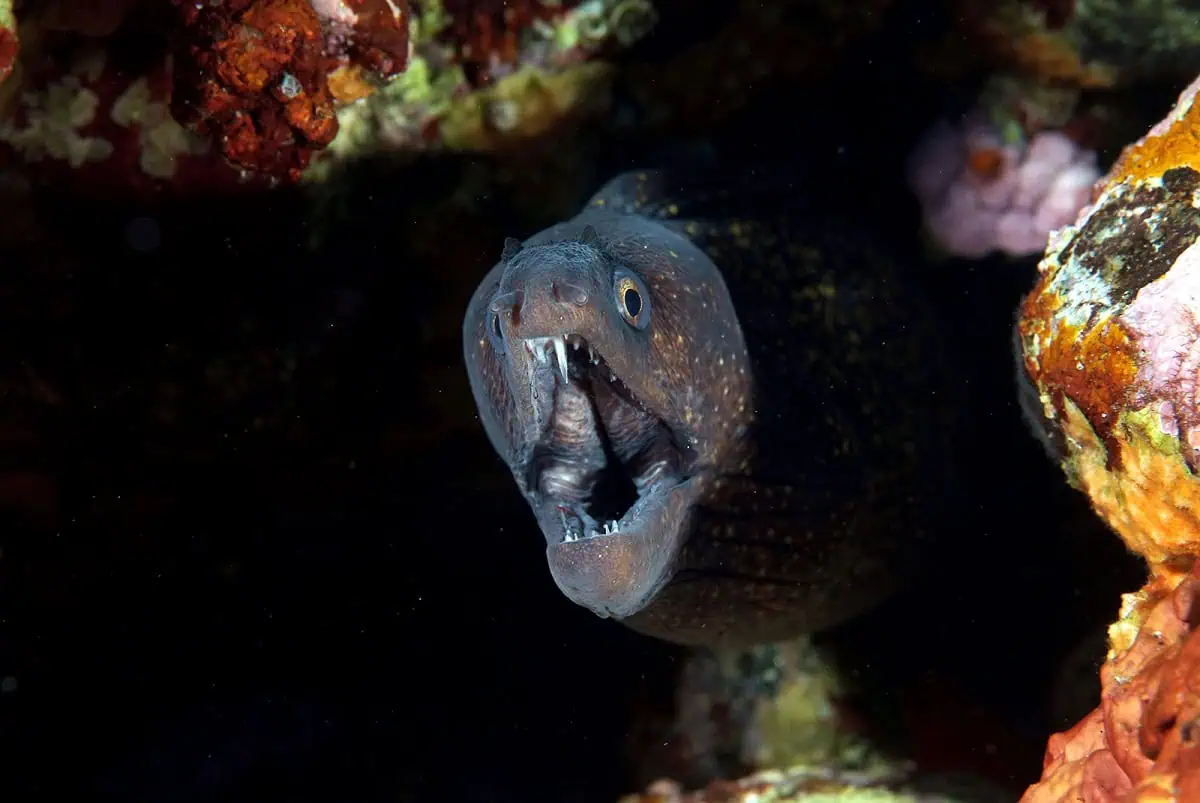
The Mediterranean moray has an elongated, snake-like body and can reach a length of 1.5 meters! They have a long dorsal fin that extends from the head all the way down the entire length of their bodies, to the tail fin. You will find them peaking out of cracks in the rocky terrain throughout the Isola bella so keep your eyes peeled! Their unscaled, slimy skin is blue to brown in colour with specks of yellow creating a beautiful pattern. Like many forms of life underwater, during the day is spent hiding in cracks and holes in rocks, becoming more active at night when they hunt. Their diet consists of a variety of food which include fish, molluscs (octopuses, squid, cuttlefish), and crabs. You will often see them opening and closing their mouths constantly which can look quite sinister! However, this gaping is necessary in order to catch enough water to be able to breath.

Family: Diogenidae (Hermit crab), Hormathiidae (Sea anemone)
Other names include: Hermit crab (Dardanus calidus), Hermit crab anemone (Calliactis parasitica)
Hermit crabs are crustaceans belonging to the superfamily Paguroidea and have adapted to occupy empty mollusk shells to protect their fragile exoskeletons. In fact, they are often found in partnership with another organism called Calliactis parasitica, a species of sea anemone. The anemone attaches itself to the hermit crab’s shell as it moves along the seabed. They share what is known as a symbiotic relationship, meaning both organisms benefit from living together. The sea anemone’s stinging tentacles help deter predators, while scraps of food left behind by the hermit crab provide the anemone with nourishment. The sea anemone can survive without the hermit crab, and the hermit crab can survive without the anemone, but they often associate with each other for mutual benefits. This type of relationship is known as mutualism. They can remain companions for life! When the hermit crab outgrows its shell and moves into a new one, it will often carefully transfer the sea anemone onto the new shell as well.

Family: Flabellinidae
Group: Flabellina
Other names include: Purple flabellina
The Purple Flabellina is a sea slug, more specifically a nudibranch. It can grow up to 5 cm long and is commonly found around Isola Bella. It feeds on the hydroid Eudendrium (a colonial organism with multiple polyps connected by tube-like hydrocauli). Wherever these hydroids are abundant, you will usually find flabellina as well. Interestingly, the best time for Flabellina to feed on hydroids is when the hydroids themselves capture and eat their prey. This means the flabellina gains energy both from the hydroid and from the prey it has captured. Like all nudibranchs, they are known for their beautiful colors and patterns. The Purple Flabellina has a deep purple body with white tips on the tentacles that float above its body. On top of its head it has a pair of rhinophores—long, rigid, screw-like tentacles. These act as sensory organs that help compensate for its weak eyesight.

Family: Euryleptidae
Other names include: Planària rosa
Another famous small creature that roams the rocky terrain of Isola Bella is the Pink Flatworm. Its beauty lies not only in its appearance but also in the way it moves. The surface of its body creates wave-like motions that allow it to glide smoothly across the terrain. They usually live on rocks, vertical walls, seaweed, sponges, or sea squirts, and are typically found at depths between 5 and 50 meters. They can grow up to about 3 cm in size, with some individuals as small as a fingernail! They have an oval and very flat shape, with a pink coloration marked by fine white stripes. Their eggs hatch directly into miniature adults. Because red tones disappear underwater, they can sometimes appear more purple in color—so bring a torch to see their true colors!

Family: Sparidae
Other names: saddle bream, oblade
One of our favourite seabreams is the saddled seabream. It has a fusiform bluish-silver body with a distinctive black spot near the tail, making it very easy to identify. They are usually around 20 centimetres long, and during the season at Isola Bella you can see families of these seabreams growing in both number and size. The saddled seabream spawns between April and June, so at the beginning of our season you can find many small individuals. Towards the end of the season, in October, they have grown significantly larger. They mainly feed on algae that can be found around Isola Bella. The Posidonia seagrass meadows are their home, and they are most commonly seen in the shallow areas around Isola Bella, close to the surface. Even Discover Scuba Divers can easily admire them!

Family: Pomacentridae
Group: Actinopterygii
Other names: Mediterranean chromis
Chromis chromis, or the Mediterranean damselfish, has an oval and laterally compressed body with a noticeably large eye. The Mediterranean variety is brown with golden-brown spots. They usually grow to around 13 centimetres in length. They like to gather in large groups around rocks, rocky reefs and seagrass meadows, which are abundant in the Isola Bella Marine Park in Taormina. Because of this, we can see them at almost every dive site. The female damselfish can lay up to 73,000 eggs and when the young fish hatch, they display a brilliant iridescent blue colour—truly beautiful to see! During the summer months, juvenile damselfish often appear in small groups.

Family: Scorpaenidae
Other names: red scorpionfish, bigscale scorpionfish, rascasse
The scorpionfish we see around the Isola Bella Marine Park are usually quite small. An important thing to know about this fish is that it has venomous spines, which it uses to protect itself from danger. The most common size we see around Taormina is about 10 centimetres, although the larger ones can grow up to 30 centimetres. They prefer rocky, sandy, or muddy bottoms at depths of around 20 metres or deeper. However, in our diving environment we can also find smaller individuals in shallower water, sometimes even just 1 metre below the surface, which means they can also be admired by snorkelers. The scorpionfish found here can have different colours: red, brown with white spots, or brown with darker blotches across the body. Inside large swim-throughs, we can sometimes find smaller red scorpionfish. Their eyes are slightly larger and reflect a bright white colour when illuminated with a dive torch.

Family: Pinndae
Other names: noble pen shell
The fan mussel is a large species of Mediterranean clam and can grow up to 120 centimetres. We can already spot them from depths of about 2 metres and deeper. They are often found among the Posidonia seagrass meadows. An interesting fact is that Pinna nobilis hosts a symbiotic shrimp that lives inside its shell. When the shrimp detects danger, it warns the fan mussel—possibly by retracting its claws or even by pinching. The clam then quickly closes its shell. It has been shown that the shrimp has a similar filter-feeding diet as its host, and their relationship is likely mutualistic, meaning both organisms benefit. The pen shell is very sensitive to pollution and, unfortunately, this species is now critically endangered. In the Isola Bella Marine Park, we have noticed that the noble pen shells are struggling. In recent years, there has been an outbreak in the Mediterranean Sea of a pathogen called Haplosporidium pinnae, which poses a serious threat to the survival of the species. For us divers, this is another reason to educate our visitors about the conservation of our marine underwater world and how we can all help protect it.

Family: Echinasteridae
Group: Asteroidea
Other names: Mediterranean red sea star
The red starfish has five relatively slender arms surrounding a small central disc. Its color is bright orange-red and it can reach a diameter of up to 20 centimetres. You can usually find it in the shallow parts of dive sites, including on rocky, sandy and muddy bottoms as well as in seagrass meadows. In the Isola Bella Marine Park we can find red, orange and dark pink starfish, the pentagon starfish in deeper areas and brittle stars during night dives. It is amazing to realize that when we look at a starfish, we are observing an ancient creature, as fossil records date back around 450 million years.

Family: Sabellidae
Group: Polychaeta
Other names include: Peacock worm, Sabella pavonina
If you didn’t know better, you might think you were looking at an underwater flower attached to the wall. But in fact, it’s a peacock worm! What you see are the striped, feathery tentacles of the worm extending from the wall. The worm itself lives inside a smooth tube made of fine mud or sand particles that are held together with mucus. The tube stands upright, with the lower end attached to stones and the upper end protruding from the seabed. The tentacles extend from the tube to feed by filtering small food particles from the water. Be careful not to get too close! If the worm feels disturbed, it will quickly retract its tentacles back into the tube. Peacock worms are often found in shallow waters at many of our dive sites and can grow between 10 and 25 centimetres in length.
Family: Myriaporidae
Group: Bryozoans
Other names: false red coral
Myriapora truncata is a bryozoan belonging to the Myriaporidae family and is often called false coral because of its resemblance to red coral, although it is much more fragile. The colony can grow up to about 10 cm wide and has short, thick branches that divide dichotomously. The surface is porous and has an intense red-orange color. Unlike true coral, whose polyps are white, the polyps of this species have the same color as the branches. Reproduction takes place between February and March. Colonies of false coral attach themselves to rocky substrates, which we can also observe in the shallow areas around Isola Bella. They can often be found in shaded areas from depths of about 1–2 meters and also deeper. Remember that, despite its coral-like appearance, this is actually an animal.

Activity
DivingSnorkelingCorsi SubTour/Noleggio BarcaLink utili
Book NowRates and OffersVacanze SubHow to Reach UsReviewsAbout usBlogShopDiving
Padi Diving Courses